
For generations, exploring the European continent has been defined by a fundamental mobility choice: the romantic rhythm of the rails or the open freedom of the highway. As international travel demand reaches record levels and European infrastructure undergoes sweeping modernization, the choice between taking the train or renting a car has evolved from a simple preference into a complex financial and logistical calculation.
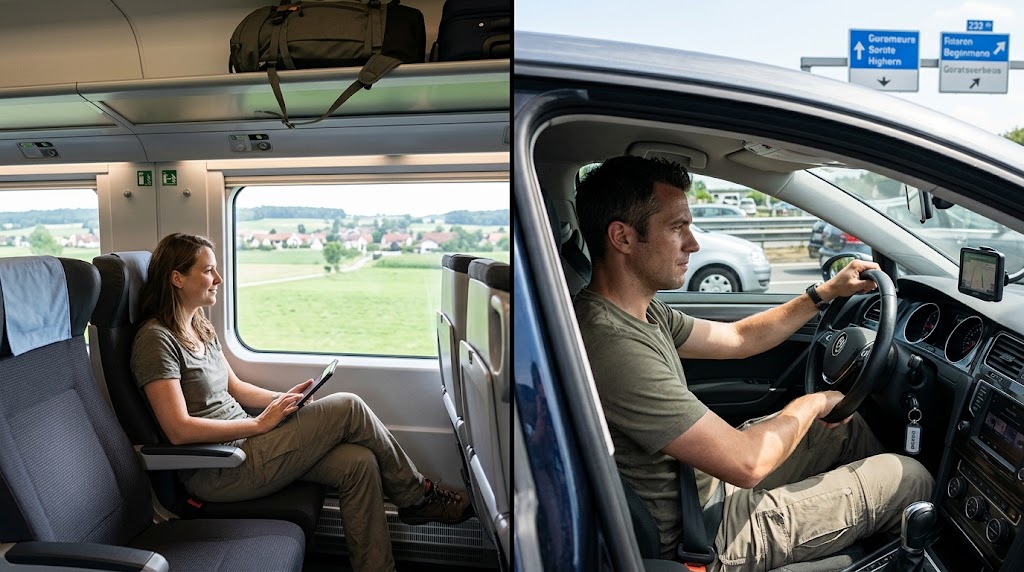
With high-speed rail networks expanding across borders and rental car companies adjusting pricing models to reflect post-pandemic fleet costs, travelers face a starkly divided transport landscape. Deciding whether to navigate Europe by train or by car requires looking beyond baseline ticket prices and daily rental rates. A true comparison demands an evaluation of door-to-door transit times, hidden ancillary costs, geographic constraints, and party size.
The Speed Fallacy: Door-to-Door Transit vs. Highway Velocity
When comparing travel times between European destinations, relying strictly on distance maps or raw transit speeds leads to misleading conclusions. The true measure of time efficiency lies in door-to-door duration.
High-speed rail networks across Western and Central Europe—such as France’s TGV, Italy’s Frecciarossa, Spain’s AVE, and Germany’s Intercity Express (ICE)—operate at commercial speeds between 250 and 320 kilometers per hour. However, the primary time advantage of train travel is not merely track velocity; it is station placement.
European train stations were built during the 19th and early 20th centuries at the geographical and cultural hearts of major cities. Departing from London St Pancras, Paris Gare de Lyon, or Amsterdam Centraal drops passengers directly into metropolitan public transit grids. Travelers typically need to arrive only 15 to 30 minutes before departure, bypassing the security lines, baggage drop procedures, and suburban airport transfers required by air travel.
Conversely, driving between major European cities introduces severe time drains that map applications rarely predict:
- Metropolitan Congestion: Entering and exiting major hubs like Paris, Rome, or Munich during morning or evening commute windows can add anywhere from 45 to 90 minutes to a journey.
- The Parking Hunt: Securing parking in dense historical centers often involves navigating narrow, single-lane streets, deciphering localized parking codes, or searching for public parking garages located outside pedestrian-only zones.
- Navigation and Rest Stops: Long-distance driving requires active driver engagement, mandatory rest breaks, and refueling stops, reducing net average speeds to roughly 80 to 100 kilometers per hour over multi-hour trips.
On high-density urban corridors—such as Madrid to Barcelona (2 hours 30 minutes by train), Paris to Brussels (1 hour 22 minutes), or Florence to Rome (1 hour 32 minutes)—high-speed rail easily defeats driving, often cutting total travel time in half.
The Financial Footprint: Ticket Fares vs. Ancillary Road Costs
Evaluating the financial expense of train travel versus car rental is where many travelers encounter budget surprises. A superficial comparison between a €40 train ticket and a €35-a-day car rental baseline ignores the extensive web of fees associated with driving in Europe.
The Hidden Costs of Car Rentals
While the advertised daily rental rate may look attractive, the total cost of driving includes several non-negotiable add-ons:
- Fuel Costs: Fuel prices in Europe remain among the highest in the world. Gasoline and diesel routinely average between €1.70 and €2.20 per liter (equivalent to approximately $7.00 to $9.00 per U.S. gallon). A 1,000-kilometer road trip in a standard compact car can easily incur €150 to €200 in fuel expenses alone.
- Highway Tolls: Major motorway networks in France (Péage), Italy (Autostrade), and Spain utilize distance-based toll systems. Driving from Paris to Nice costs roughly €80 in one-way tolls. Countries like Switzerland, Austria, and the Czech Republic require drivers to purchase physical or digital vignettes (highway permits) before accessing motorways, adding fixed costs regardless of distance driven.
- Urban Parking Rates: Overnight parking in European city centers is exceptionally expensive. Hotel garages and public parking structures in cities like Amsterdam, Venice, or London routinely charge between €35 and €65 per 24-hour period.
- One-Way Drop-Off Fees: Returning a rental car to a different location than where it was picked up triggers substantial drop-off surcharges. If the drop-off occurs across an international border—for instance, picking up in Frankfurt and dropping off in Zurich—surcharges can range from €300 to over €1,000.
- Traffic Enforcement and ZTL Fines: Cities across Italy feature Zone a Traffico Limitato (ZTLs)—restricted traffic zones designed to protect historic centers. Foreign drivers who inadvertently enter these zones are photographed by automated cameras, resulting in fines ranging from €110 to €350 per violation, often forwarded through rental agencies alongside administrative handling fees.
The Dynamics of Rail Pricing
Rail travel costs, by contrast, operate on dynamic pricing models similar to airlines. Passengers who book high-speed intercity tickets two to three months in advance can secure deep discounts—often buying seat reservations on premier routes for €15 to €35.
However, travelers who purchase tickets on the day of travel or during peak holiday windows face walk-up fares that can exceed €150 per leg. Additionally, while regional local trains maintain fixed, low-cost pricing without reservation requirements, high-speed international trains (such as Eurostar or Thalys/Eurostar Continental) require mandatory seat reservation fees even for pass holders.
The Demographics of Value: Solo Travelers, Couples, and Families
The financial math comparing trains and cars shifts dramatically depending on the size of the travel group.
Cost Efficiency by Group Size & Geography

Solo Traveler / Couple  --->  Major City Corridors  --->  TRAIN WINS
Small Group / Family    --->  Rural & Multi-Stop    --->  CAR WINS
For solo travelers and couples, train travel is almost universally more economical. Two advanced-purchase train tickets between major hubs will almost always cost significantly less than the combined daily rental rate, insurance, fuel, tolls, and parking fees of a vehicle.
For families or groups of three to five adults, the economic equation flips. While rail fares must be purchased individually for every passenger—multiplying total transit costs by three, four, or five—a rental car represents a fixed vehicle cost. The rental price, fuel expenses, and parking fees remain constant whether the vehicle carries one driver or five passengers.
Furthermore, carrying multiple large suitcases on European trains can introduce physical strain during tight transfers between platforms, whereas a station wagon or SUV accommodates group luggage within a single trunk.
Geography Dictates Transit: Urban Corridors vs. Countryside Loops
The decision between rail and road ultimately depends on itinerary geography. Europe’s transit infrastructure is optimized for distinct types of terrain and regional density.
Where Trains Reign Supreme: Metropolitan Routes
If an itinerary focuses on major historical capitals and regional urban centers—for example, a route connecting London, Paris, Brussels, and Amsterdam, or an itinerary linking Munich, Vienna, and Budapest—renting a car is an inefficient choice.
In these dense urban areas, public transportation networks (subways, trams, buses) are comprehensive, low-cost, and user-friendly. A car becomes a financial and logistical liability, spending most of its time parked in expensive garages while its driver navigates unfamiliar traffic laws.
Where Cars Are Essential: Rural and Regional Exploration
Conversely, Europe’s true scenic treasures—the rolling hills of Tuscany, the medieval villages of the Dordogne, the fjords of Norway, the coastal drives of Ireland, or the mountain passes of the Bavarian Alps—are poorly served by high-speed rail.
While regional trains and local buses do connect smaller towns, service frequency is often sparse, weekend schedules are restricted, and route connections can turn a simple 30-minute drive into a three-hour multi-bus journey. A rental car provides unparalleled freedom in rural landscapes:
- Spontaneity: The ability to stop at roadside markets, family-owned wineries, and uncrowded viewpoints unavailable to scheduled transit.
- Off-Peak Access: Visiting popular natural attractions or historic sites early in the morning before tourist tour buses arrive.
- Luggage Security: Storing luggage in a concealed trunk while exploring remote villages during day-long drives between accommodations.
The Environmental and Stress Equation
Beyond time and financial metrics, modern travelers increasingly evaluate the human and environmental impacts of their transit choices.
From an environmental standpoint, high-speed rail is by far the most sustainable method of long-distance transport in Europe. The vast majority of European rail lines are fully electrified, drawing power from increasingly renewable national grids. Taking a high-speed train generates up to 90 percent fewer carbon emissions per passenger compared to driving an equivalent distance in a internal combustion engine vehicle.
From a psychological perspective, rail travel transfers the stress of navigation, traffic, and weather conditions from the traveler to professional railway staff. On a train, travelers can use transit time produktively: working on laptops, reading, enjoying meals in dining cars, or sleeping. Driving across unfamiliar international highways, parsing foreign road signs, and maintaining focus in heavy traffic represents an ongoing cognitive load that can add fatigue to a vacation.
The Hybrid Compromise: The Optimal European Strategy
Rather than viewing train travel and car rental as mutually exclusive options, seasoned European travelers increasingly adopt a hybrid approach that maximizes the strengths of both modes.
The hybrid strategy splits an itinerary into distinct phases:
- Phase 1 (The Long-Distance Hops): Utilize high-speed rail to travel rapidly between primary hub cities (e.g., taking the train from Paris to Bordeaux, or from Zurich to Milan). This eliminates long highway drives, tolls, and heavy fuel expenses.
- Phase 2 (The Regional Loop): Rent a car from a central train station upon arrival at the regional gateway. Use the vehicle for three to four days to explore surrounding villages, countryside accommodation, and national parks.
- Phase 3 (The Return): Drop the rental car off at the same regional station before boarding a high-speed train back to a major hub or departure airport, avoiding cross-border drop-off fees and inner-city traffic.
Final Decision Framework
To determine the ideal transportation method for your upcoming European journey, evaluate your trip against this quick decision matrix:
Choose Train Travel If:
- Your itinerary consists primarily of major metropolitan cities.
- You are traveling solo or as a couple.
- You are comfortable booking tickets 60 to 90 days in advance to secure low fares.
- You prioritize environmental sustainability and low-stress travel.
- You want to work, read, or relax while moving between destinations.
Choose Car Rental If:
- Your trip focuses on rural regions, coastal areas, or small mountain villages.
- You are traveling with a family or a group of three or more people.
- You require spontaneous, flexible scheduling without fixed departure times.
- You are carrying heavy or non-standard luggage (e.g., sports equipment, camping gear).
- You plan a round-trip loop starting and ending in the same regional location.
By aligning your transportation choice with your group size, geographic scope, and budget priorities, you can ensure that your journey across Europe is optimized for both time and cost efficiency.