
On a Tuesday afternoon in Lisbon, a senior product manager closes her laptop on the sunlit terrace of a neighborhood café. Within minutes, she is walking through the steep, narrow alleys of the historic Alfama district, meeting friends for a dinner of fresh grilled sardines and local wine. Her workday is complete, her quarterly deliverables remain entirely on track, and her annual leave balance remains completely untouched.
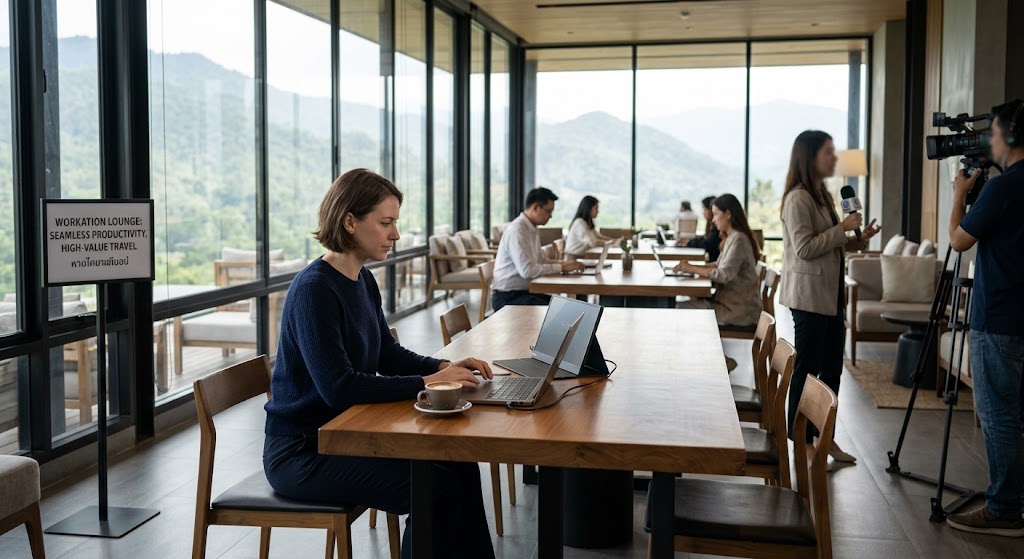
Scenes like this are playing out across coastal towns, alpine villages, and cultural capitals worldwide. The concept of the “workation”—a portmanteau blending professional obligations with extended leisure travel—has completed a rapid transition. What began as an informal, experimental reaction to remote work during the early 2020s has solidified into a permanent structural pillar of global mobility.
More significantly, this shift is fundamentally redefining what it means to be a “high-value traveler.”
For decades, the luxury travel industry defined high value through a narrow lens: high-end five-star resorts, private transfers, butler services, and dense, highly orchestrated itineraries packed into a precious four- or five-day vacation window. Today, a new metric of value has taken hold among mobile professionals and hospitality providers alike. High-value travel is no longer measured solely by the opulence of an accommodation or the speed of an itinerary. Instead, it is defined by duration, autonomy, cultural integration, and the ability to explore the world without halting professional momentum or sacrificing personal well-being.
The New Metric of Travel Value: Depth Over Density
The traditional corporate vacation was built around a fundamental trade-off: time was scarce, so spending had to be high. Working professionals compressed an entire year’s worth of travel aspirations into two or three short, high-stress weeks. The result was often a frantic “checklist” style of tourism—rushing through airports, checking into hotels for forty-eight hours, hitting major tourist monuments, and returning home more exhausted than when the journey began.
The workation fundamentally alters this mathematical equation. By maintaining daily professional responsibilities during standard working hours, travelers can extend a stay in a single location from three days to three weeks or even a month.
This extension of time changes the nature of the travel experience:
- Lower Daily Pace: With weeks rather than days at their disposal, travelers step off the tourist treadmill. There is no urgent compulsion to visit three museums before lunch.
- Neighborhood Integration: Extended stays encourage travelers to shop at local produce markets, frequent neighborhood bakeries, and establish daily routines that foster genuine cultural connection.
- Greater Financial Efficiency: On a per-day basis, long-stay accommodations, regional transport passes, and local grocery shopping yield a far higher return on investment than high-turnover, short-term tourist packages.
For the modern mobile professional, true travel luxury is no longer about being waited on hand and foot for forty-eight hours. It is about having the temporal freedom to live, work, and dine in a foreign culture over a sustained period.
The Corporate Policy Evolution: From Shadow Remote Work to Formalized Benefits
In the immediate aftermath of the remote-work explosion, taking a workation was often an underground exercise. Employees frequently worked from beach towns or mountain cabins while using digital backgrounds on video calls to conceal their location from human resources departments.
That era of “shadow remote work” has given way to formal corporate governance. Human resources leaders across technology, finance, consulting, and creative sectors now recognize that offering structured workation policies is one of the most cost-effective talent retention tools available.
CORPORATE WORKATION POLICY EVOLUTION

UNSANCTIONED ERA (2020–2022)
* Informal "shadow" remote work
* Hidden locations and digital backgrounds
* High legal and tax compliance risks
* Unclear expectations between managers and staff

FORMALIZED ERA (2023–PRESENT)
* Structured "Work From Anywhere" (WFA) allowances (e.g., 30–90 days/year)
* Integrated tax and residency tracking platforms
* Clear performance and core-hours SLAs
* Recognized tool for talent acquisition and burnout prevention
A significant majority of remote-capable organizations now offer explicit “Work From Anywhere” (WFA) allowances, typically granting employees between 30 and 90 days per calendar year to perform their duties from outside their primary home jurisdiction.
The corporate incentives behind this shift are compelling:
- Talent Acquisition and Retention: In competitive professional sectors, flexible location policies consistently rank alongside salary in candidate evaluations. Offering a formal workation framework allows employers to attract top-tier talent without inflating baseline compensation packages.
- Burnout Mitigation:Workplace surveys consistently show that extended environment changes significantly reduce employee exhaustion.Employees return from workations reporting higher job satisfaction, renewed creative focus, and lower stress levels, directly reducing costly sick leave and workplace attrition.
- Institutionalized Compliance: The rise of specialized global HR compliance platforms has resolved corporate fears regarding cross-border tax liabilities and labor laws. Automated software now tracks employee location thresholds in real time, ensuring workers do not trigger tax residency issues while working abroad.
The Hospitality Pivot: Designing the Hybrid Work Sanctuary
The global hospitality sector has undergone a massive operational redesign to capture this lucrative market segment. Traditional hotels built around short-stay leisure guests or brief business travelers faced severe structural vulnerabilities: high weekend occupancy followed by deep mid-week slumps.
Workationers have solved this occupancy volatility. By booking stays that span multiple weeks, mobile workers fill mid-week room inventory, providing hotels with predictable, high-margin baseline revenue.
To attract these high-value, long-stay guests, major hotel chains, boutique properties, and resort operators have systematically overhauled their physical infrastructure and service offerings:
Essential Infrastructure Upgrades
Standard hotel desks and spotty Wi-Fi are no longer acceptable. Modern workation-friendly properties now feature high-speed, symmetrical fiber-optic internet, dedicated ergonomic workstations inside guest rooms, dual-monitor rental options, and soundproof acoustic pods in public areas for private video conference calls.
Integrated Co-Working Lounges
Hotels are converting underutilized lobbies and conference rooms into vibrant co-working spaces.These areas blend hospitality services—such as specialty coffee bars and craft beverage counters—with professional office infrastructure, allowing guests to transition seamlessly between focused work and social networking.
Tiered Long-Stay Packages
Yield management models have shifted from daily pricing to weekly and monthly tiered rates. Long-stay packages frequently bundle essential lifestyle services, including complimentary laundry allowances, gym memberships, co-working desk access, and daily breakfast, creating an all-inclusive residential experience.
This pivot has given rise to a fast-growing “Work From Hotel” sector, turning traditional hospitality venues into multi-functional residential hubs for global professionals.
Rebalancing the Tourism Economy: Mitigating Overtourism and Seasonality
Beyond individual wellbeing and corporate productivity, the rise of workations is offering a practical solution to one of the global travel industry’s most pressing problems: overtourism.
Popular tourist destinations across Europe, Asia, and Latin America have long struggled with the destructive economics of hyper-seasonality. Millions of short-term tourists flood primary capital cities and coastal hotspots during a two-month summer peak, placing immense strain on local transit, water infrastructure, and housing markets, only to vanish during the shoulder and off-peak seasons.
Workationers operate under entirely different geographic and seasonal priorities:
- Spreading Economic Impact Beyond Tourist Centers:Because workationers seek quiet working environments and authentic lifestyle experiences, they frequently select secondary and tertiary destinations—such as regional coastal towns, mountain valleys, or mid-sized cultural cities—rather than congested primary capitals.
- Smoothing Seasonal Fluctuations: Remote workers are not tied to school holiday calendars or traditional summer vacation weeks. They routinely travel during shoulder seasons (autumn and spring) or winter months, sustaining local restaurants, cafes, and transportation providers year-round.
- Direct Community Reinvestment: Unlike short-stay cruise ship visitors or weekend tour groups who spend money almost exclusively at high-turnout tourist attractions, workationers contribute directly to the foundational economy. Their daily spend flows into local grocery stores, neighborhood laundromats, fitness studios, and independent coffee shops.
Recognizing this economic potential, more than 60 national governments have established specialized remote work visas and digital nomad permits. These legal frameworks allow mobile professionals to reside legally in host nations for six to twelve months, capturing high-earning international tax revenue without competing with local populations for domestic jobs.
The Psychological ROI: Dissolving the Friction Between Labor and Leisure
The traditional vacation framework carried an unspoken mental health penalty: the stress of departure and return. Clearing a desk before taking time off often required working grueling hours, only to be followed upon return by hundreds of unread emails and an overwhelming backlog of project tasks.
The workation eliminates this artificial boundary between work and life.Because professional duties are maintained continuously, there is no inbox backlog, no frantic clearing of tasks, and no post-vacation re-entry shock.
MENTAL HEALTH & PRODUCTIVITY PROFILE OF WORKATIONERS
(Data compiled across global workforce travel studies)

* 86% report a measurable increase in daily workplace productivity.
* 84% report higher job satisfaction and overall career fulfillment.
* 83% report significant reduction in symptoms of professional burnout.
* 81% report heightened creative thinking and problem-solving capacity.
The psychological benefit of a workation lies in what behavioral psychologists call the “after-hours effect”.
When a professional steps away from their laptop at 5:00 PM in their home city, their evening often consists of an exhausting suburban commute, household chores, and familiar routines. When that same professional steps away from their laptop at 5:00 PM on a workation, their evening immediately transforms. Within minutes, they can be swimming in the ocean, exploring a historic museum, or dining at an unfamiliar neighborhood bistro.
This immediate access to novel environments stimulates cognitive creativity, breaks workplace monotony, and provides deep psychological restoration without requiring a single day of annual leave.
Managing the Boundaries: Discipline and the Risk of Toxic Productivity
While the benefits of workations are substantial, the model is not without personal and operational challenges.Combining professional responsibilities with a travel environment requires strict self-discipline and clear boundary management.
Without intentional structure, workations can succumb to specific failure modes:
- The Blurred Work-Life Trap: The most common mistake travelers make is failing to separate working hours from leisure time. When laptop screens remain open late into the evening, travelers risk experiencing the worst of both worlds: working long hours in a beautiful destination without ever truly experiencing the place.
- Time Zone Friction: Working remotely across multiple time zones demands careful schedule coordination. A professional working for a New York company while staying in Southeast Asia or Southern Europe may find themselves taking client calls late into the night, disrupting sleep cycles and limiting evening social activities.
- Local Housing Pressures: The rapid influx of high-earning foreign remote workers into popular destinations can inadvertently inflate long-term residential rental prices, creating friction with local working-class residents. Sustainable workations require travelers to engage with local communities responsibly and support housing policies that protect local affordability.
Successful workationers manage these risks by setting explicit core working hours with their teams, choosing destinations with compatible time zones, and establishing firm daily rituals that mark the end of the workday.
A Permanent Transformation of Global Travel
The rise of the workation is far more than a temporary workplace trend or a passing travel fad. It represents a permanent, structural realignment of how human beings view the relationship between labor, geography, and personal time.
As flexible work arrangements become permanently woven into global business practices, the traditional boundaries that separated corporate travel from leisure travel have dissolved. High-value travel is no longer defined by how much money a person can spend during a brief weekend getaway. It is defined by the freedom to move seamlessly across the globe, maintaining professional excellence while experiencing the richness of the world in real time.
By prioritizing duration over speed, integration over isolation, and sustained well-being over temporary escape, workations have redefined what it means to travel well—offering a far richer, more sustainable model for the global traveler of the modern era.