
For generations, the global summer holiday followed a predictable script. Millions of travelers squeezed into identical departure lounges, flew toward guaranteed sunshine on the Mediterranean or tropical coasts, and queued under a blistering sun to view famous landmarks. Success was measured by the density of the itinerary, the heat of the beach, and the checklist of famous sights crossed off before heading home.
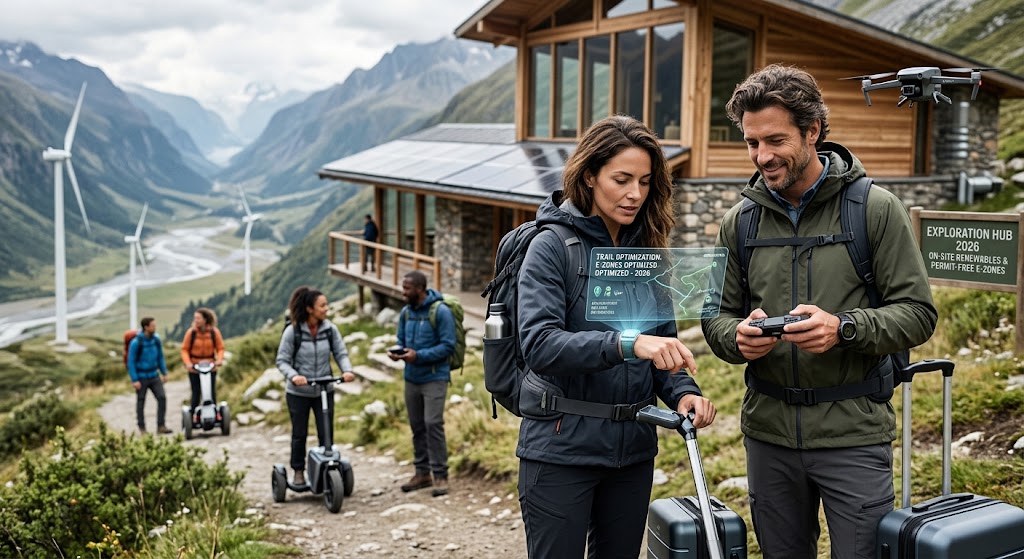
That legacy template is rapidly unraveling.
In 2026, international leisure travel is undergoing its most profound recalibration in decades. Faced with record-breaking summer heatwaves across traditional holiday hotspots, escalating friction from urban overtourism, and a widespread cultural shift toward cognitive rest, travelers are rewriting the rules of engagement.The modern holidaymaker is stepping away from viral, high-density hotspots in favor of climate-resilient destinations, overland rail journeys, mid-career sabbaticals, and quiet, intentional escapes.
Understanding where smart holidaymakers are heading next requires looking beyond marketing brochures and examining how climate realities, economic discernment, and changing psychological needs are shaping the global tourism landscape.
The “Coolcation” Pivot: Swapping Scorching Heat for Alpine Air and Nordic Glaciers
Perhaps the single most disruptive force shaping summer travel in 2026 is the rapid rise of the “coolcation”.As mid-summer temperatures across Southern Europe, North Africa, and the Southern United States routinely breach 40°C (104°F), the traditional appeal of guaranteed coastal heat has transformed into a distinct physical discomfort.
Instead of chasing sweltering beach loungers in Southern Europe or Asia, travelers are deliberately heading north or climbing higher in elevation. Search volumes for cooler-climate destinations during peak summer months have surged by more than 70 percent compared to previous seasons, turning what was once a niche preference into a dominant industry trend.
REGIONAL CLIMATE AND TRAVEL SHIFTS

TRADITIONAL SUMMER HOTSPOTS
* Summer Range: 35°C to 42°C (95°F to 108°F)
* High risk of heat warnings, urban heat island effect, and seasonal wildfires
* Saturated infrastructure and crowded coastal strips

COOLCATION DESTINATIONS
* Summer Range: 12°C to 24°C (54°F to 75°F)
* Optimal conditions for hiking, outdoor dining, and continuous sightseeing
* High concentration of alpine lakes, fjords, glacial valleys, and expansive wilderness
This thermal migration has redirected significant travel capital toward Scandinavia, the Baltic States, and high-altitude alpine corridors.
- The Nordic Arc:Iceland, Norway’s fjord country around Bergen, and Swedish Lapland have recorded record-breaking summer bookings, with travelers drawn to long daylight hours and daytime temperatures that rarely exceed 18°C.
- The Alpine Alternatives:Destinations like Slovenia’s Lake Bohinj—positioned in the heart of Triglav National Park—are capturing visitors seeking crisp mountain waters and cool mountain air while avoiding the heavy crowds and inflated pricing of neighboring commercial lakes.
- Eastern European Peaks:Slovakia’s High Tatras and the high-elevation valleys of Georgia’s Svaneti region are emerging as premier summer sanctuaries, offering majestic glacial lakes, dramatic trekking routes, and cool mountain air at a fraction of Western European prices.
The coolcation movement represents more than a temporary reaction to weather forecasts; it reflects a long-term structural adjustment in how travelers plan around climate realities.
“Destination Dupes” and the Rejection of Over-Touristed Hotspots
For years, social media algorithms created a concentrated feedback loop in global travel. Millions of visitors converged on the exact same photo locations in places like Venice, Barcelona, Santorini, and Kyoto, creating localized infrastructure crises and sparking localized resident protests.
In 2026, the reaction against overtourism has reached a tipping point. Discriminating holidaymakers are actively seeking out “destination dupes”—lesser-known, low-density locations that offer equivalent architecture, culture, or natural beauty without the crowds, municipal entry fees, or hostility associated with hyper-commercialized hubs.
THE DESTINATION DUPE MATRIX

OVERCROWDED TRADITIONAL HUB
* Venice / Amalfi Coast (Italy)
* Swiss Alps (Switzerland)
* Santorini (Greece)
* Kyoto (Japan)

LOW-DENSITY "DUPE" ALTERNATIVE
* Inland Croatia / Treviso (Italy)
* High Tatras (Slovakia)
* Albanian Riviera / Dhermi (Albania)
* Luang Prabang / Northern Laos
This strategy is driving remarkable growth in secondary and tertiary markets:
- The Balkans: Travelers seeking dramatic coastal scenery and historic stone villages without Western European price tags are heading to the Albanian Alps and the coastal corridors of Montenegro and Albania.
- Central Asia and Southeast Asia:Destinations like Laos—up more than 30 percent in year-over-year bookings—and Kyrgyzstan are benefiting from travelers looking for authentic cultural immersion, pristine mountain passes, and historic Silk Road heritage far removed from mass-tourist trails.
- South America’s Interior: Rather than sticking exclusively to primary coastal capitals, long-haul visitors are heading deeper into regional hubs like Colombia’s Coffee Triangle, where boutique coffee haciendas and lush cloud forests offer quiet, sustainable exploration.
By prioritizing non-viral destinations, travelers enjoy lower daily expenses, authentic interactions with local hosts, and the freedom to explore without navigating crowd-control barriers or digital reservation queues.
The “Micro-Retirement”: Reclaiming the Big Trip Mid-Career
The traditional life script dictated that ambitious, multi-week “trip of a lifetime” itineraries—such as trekking through Patagonia, exploring Central Asia, or taking a month-long overland journey across Southeast Asia—were reserved for formal retirement.
As official retirement ages continue to shift globally, mid-career professionals are systematically rejecting the wait. The concept of the “micro-retirement”—a structured, multi-week sabbatical taken in one’s 30s, 40s, or 50s—has emerged as a defining travel trend.
Driven by remote-work flexibility, corporate sabbatical allowances, and a heightened awareness of work-life balance, professionals are taking extended leaves of absence to accomplish bucket-list journeys while in their physical prime.
Tour operators and travel providers have adapted swiftly to this shift:
- Back-to-Back Itineraries: Travel companies report significant demand for connected, multi-destination itineraries that allow sabbatical takers to combine multiple regional explorations into a single continuous four-to-six-week journey.
- Active Adventure Focus: Unlike traditional senior retirement travel, micro-retirements lean heavily into physical endurance and immersion—such as high-altitude trekking in the Andes, long-distance sea kayaking, or multi-week wildlife conservation projects in Southern Africa.
- Professional Reset: These extended breaks are explicitly designed as psychological circuit breakers, giving mid-career workers an opportunity to step off the corporate treadmill, prevent professional burnout, and return to work with renewed perspective.
The Rail Revival: Slow Overland Journeys as the Main Event
The era of relying on cheap, high-friction short-haul flights to hop between close regional destinations is waning across Europe, Asia, and North America. In its place, passenger rail is experiencing a major renaissance, embraced not merely as a lower-carbon transport choice, but as a superior, highly atmospheric way to travel.
OVERLAND RAIL VS. SHORT-HAUL FLIGHT

SHORT-HAUL FLIGHT
* Transit Reality: Outlying airport commutes, 2-hour security queues, luggage limits
* Environmental Impact: High aviation carbon emissions per passenger-kilometer
* Experience: Functional, fragmented, highly stressful

PASSENGER RAIL
* Transit Reality: Downtown-to-downtown arrival, generous baggage allowance, onboard space
* Environmental Impact: Minimal carbon footprint (frequently electric-powered)
* Experience: Panoramic scenery, restful workspace, seamless cultural transitions
Rail booking figures across major international transit platforms have grown by over 25 percent year-over-year, supported by substantial infrastructure investments:
- Restored European Night Trains: The expansion of cross-border night train networks—connecting capitals like Vienna, Berlin, Paris, Brussels, and Rome—allows travelers to convert travel time into a restful night’s sleep, dropping them directly into central urban cores without losing a daylight day to transit.
- Pan-Asian High-Speed Lines: High-speed rail corridors in East and Southeast Asia are transforming regional itineraries, making overland journeys through mountainous terrain faster and more comfortable than flying.
- Trans-Alpine and Balkan Routes: Scenic rail corridors—such as Switzerland’s Glacier Express, Norway’s Flåm Railway, and regional lines through the Balkans—are being booked as core holiday highlights rather than simple transport legs.
Traveling by train strips away airport security queues, luggage fees, and suburban transfers, allowing the landscape itself to become an integral part of the holiday experience.
“Hushpitality” and the Pursuit of the “Whycation”
In an era dominated by hyper-connectivity, continuous notifications, and workplace cognitive overload, the fundamental motivation for taking a holiday has shifted. Travelers are moving away from passive leisure toward intentional, purpose-driven journeys—a trend known industry-wide as the “whycation”.
Before booking, holidaymakers are asking a fundamental question: Why am I taking this trip?For an increasing number of travelers, the answer is a need for mental restoration, sensory detox, and emotional grounding.
This mindset has fueled two major accommodation trends:
1. “Hushpitality” and Silent Escapes
The hospitality industry is responding to sensory fatigue by creating spaces explicitly designed around quietness, spatial simplicity, and digital detoxing. Properties located in remote glacial valleys, island archipelagos, or rural mountain passes are removing televisions, establishing phone-free common areas, and offering silent retreats. The luxury asset of 2026 is not gold leaf or butler service; it is absolute silence and unpolluted night skies.
2. Converted Heritage Lodgings
Travelers are increasingly shunning sterile, standardized hotel chains in favor of properties with deep historical character.Interest has peaked in converted heritage structures—such as Spain’s historic paradores, Portugal’s pousadas, former French manor homes, restored convents, and rock-hewn cave dwellings in Central Europe. Staying in a building that has stood for centuries anchors the traveler in the history of the region, providing a sense of place that modern developments cannot replicate.
THE EVOLUTION OF VACATION MOTIVATIONS

TRADITIONAL LEISURE MODEL
* Primary Goal: Escapism and status verification
* Activities: High-density sightseeing, shopping, nightlife
* Setting: Saturated tourist resorts and primary mega-cities

INTENTIONAL "WHYOCATION" MODEL
* Primary Goal: Cognitive reset, personal restoration, and skill immersion
* Activities: Digital detoxing, community conservation, heritage exploration
* Setting: Quiet wilderness lodges, converted heritage stays, rural villages
Community-Led Wellness and Ancestral Roots
Alongside the search for quietness, 2026 travel is marked by a desire for deep human connection and personal relevance.
Beyond the Spa: Community-Led Wellness
Wellness travel has evolved past traditional hotel spas and thermal baths.Today’s holidaymakers seek restoration through meaningful cultural engagement—participating in organic farm-to-table harvests, joining community-led rewilding projects, or learning ancient culinary techniques directly from host families in regional villages. This hands-on involvement provides a sense of purpose that extends far beyond physical relaxation.
Ancestry and Heritage Journeys
Driven by accessible genetic testing and digital archival research, “ancestry travel” has become a major motivation for long-haul journeys. Travelers are organizing dedicated trips to visit the specific rural villages, historical archives, and ancestral homelands of their grandparents or forebears.These journeys carry an emotional weight that transforms a standard holiday into a deeply personal pilgrimage.
The New Blueprint for the Discriminating Traveler
The emerging travel trends of 2026 reveal a global audience that is becoming far more discerning, deliberate, and practical about how it spends its leisure time and capital.
The modern traveler is no longer interested in fighting crowds in sweltering 40-degree heat simply to check a famous landmark off a list.By choosing cooler climates, seeking out destination dupes, boarding overland trains, and booking intentional, restorative stays, smart holidaymakers are reclaiming the true purpose of travel.
Ultimately, travel in 2026 is returning to its most valuable form: an opportunity to step off the treadmill of daily life, connect authentically with new cultures and landscapes, and return home genuinely restored.