
For nearly a decade, the narrative of location-independent work was framed by a distinct set of European imagery: typing on a laptop from a sun-drenched balcony in Lisbon, taking afternoon coffee breaks in Barcelona’s Gothic Quarter, or spending mild winters near the Acropolis in Athens.
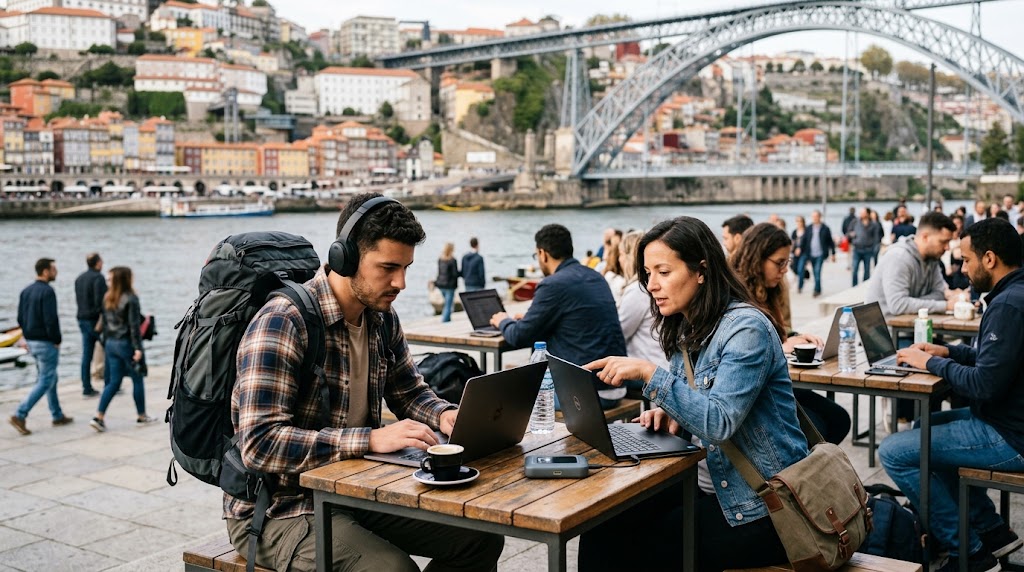
Between 2020 and 2024, Western Europe’s major capital cities and flagship metropolitan hubs enthusiastically embraced the digital nomad boom. Eager to attract global talent and foreign capital in the wake of pandemic-era travel disruptions, national governments introduced specialized digital nomad visas, lowered income thresholds, and marketed their primary cities as the ultimate lifestyle destinations for remote professionals.
Today, that landscape looks fundamentally different.
Across Europe, the primary capitals that pioneered the digital nomad movement are experiencing a pronounced cooling trend. Location-independent workers are quietly quietly packing their bags and vacating cities like Lisbon, Barcelona, Dublin, and Athens. In their place, a secondary migration is taking hold. Remote professionals are redirecting their focus toward mid-sized cities, mountain villages, coastal towns, and non-Schengen borderlands—places like Valencia, Bansko, Tirana, Porto, and the Canary Islands.
This geographic realignment is not an indication that remote work is dying out. Rather, it represents a structural maturation of the nomadic lifestyle. Driven by runaway housing costs, shifting tax structures, local political pushback, and a desire for authentic community, the global remote workforce is fundamentally reassessing what it means to live and work abroad.
The Economic Breakdown: When Capitals Lose Their Value Proposition
At its core, the initial appeal of digital nomadism rested on a simple economic concept: geographic arbitrage. Remote workers earning salaries in strong currencies—such as the U.S. dollar, British pound, or northern European euro—could relocate to Southern or Eastern European capitals where the local cost of living was significantly lower. This arrangement allowed workers to enjoy a high standard of living, save money, and experience a new culture simultaneously.
Over the past three years, that financial equation has largely broken down in Western Europe’s primary cities.
As thousands of foreign remote workers, short-term tourists, and real estate investors descended on capitals like Lisbon and Athens, residential rental markets faced severe supply shortages. Landlords quickly realized they could earn far higher returns by converting long-term residential housing into short-term vacation rentals or high-end co-living spaces tailored exclusively to high-earning foreigners.
The resulting price inflation was swift and severe. In Lisbon, where the national minimum wage hovers around €920 per month, average monthly rents for a one-bedroom apartment in central neighborhoods climbed past €1,500 to €2,000. In Barcelona and Athens, housing costs followed a similar upward trajectory, effectively eliminating the cost-of-living advantage that had initially drawn international remote workers to those markets.
When a digital nomad realizes that renting an apartment in central Lisbon or Dublin requires a budget comparable to mid-tier cities in North America or Northern Europe, the financial logic of remaining in a crowded capital evaporates. The high cost of daily living—compounded by expensive dining, tourist-oriented service markups, and rising co-working space fees—has driven remote workers to seek destinations where geographic arbitrage remains functionally intact.
Tightening Regulations, Tax Changes, and Visa Realities
While market forces drove up the cost of living in major capitals, European policymakers began systematically dismantling the regulatory incentives that originally attracted location-independent workers.
During the initial digital nomad boom, several European nations offered generous tax breaks and straightforward pathways to temporary residency. Portugal’s Non-Habitual Resident (NHR) tax regime, for instance, allowed qualified foreign arrivals to enjoy flat 20 percent income tax rates or complete exemptions on foreign-sourced dividend income. Spain introduced its popular Beckham Law provisions, which capped tax rates at 24 percent for qualifying foreign employees.
However, as public dissatisfaction over housing affordability intensified, national governments faced intense domestic pressure to rein in tax incentives perceived as favoring wealthy foreigners over local citizens.
Portugal systematically restructured its NHR tax scheme, tightening eligibility criteria and removing many of the broad exemptions that had made the country a global tax haven for remote freelancers and tech workers. Simultaneously, Portuguese immigration authorities raised the minimum monthly income requirement for the country’s D8 Digital Nomad Visa to four times the national minimum wage—requiring applicants to prove income exceeding €3,680 per month.
In Spain, while the Digital Nomad Visa remains highly sought after, self-employed freelancers faced sobering administrative realities. The Beckham Law’s flat-tax benefits largely exclude independent freelancers registered as sole proprietors (autónomos), leaving them subject to Spain’s progressive tax brackets, which can reach up to 47 percent, alongside mandatory social security contributions.
Compounding these regulatory shifts is the deployment of the European Union’s automated Entry/Exit System (EES). Designed to digitally record biometric data and track entry and exit dates across the Schengen Area, the system has effectively eliminated the informal practice of “border-hopping” to reset the standard 90-day tourist allowance. For non-EU nomads who previously relied on regulatory ambiguity to move casually between Western European capitals, strict digital enforcement has made formal compliance—or relocation to non-Schengen destinations—an operational necessity.
Social Friction and the Anti-Gentrification Pushback
Beyond economics and immigration law, the psychological atmosphere inside Europe’s major capitals has shifted.
In cities like Barcelona, Athens, Palma de Mallorca, and Lisbon, the rapid concentration of foreign remote workers and short-term tourists fueled growing resentment among local populations. Neighborhoods that had historically supported working-class families saw traditional bakeries, grocery stores, and local cafes replaced by high-end brunch spots, specialty coffee shops, and boutique fitness studios catering exclusively to English-speaking transients.
This rapid cultural transformation triggered public pushback. Protests against overtourism and housing displacement erupted across Southern Europe, with activists marching through city centers, plastering anti-gentrification graffiti on residential buildings, and demanding strict caps on tourist accommodations.
For many digital nomads, this social friction altered the emotional reality of daily life. The primary motivation for adopting a location-independent lifestyle is often cultural immersion, personal connection, and the enjoyment of local hospitality. Finding oneself viewed not as a welcome guest, but as an active driver of neighborhood displacement, created uncomfortable social dynamics.
Remote workers seeking a sense of community realized that remaining in saturated mega-cities meant living inside a transient, insular “expat bubble.” To find welcoming environments where their presence contributes positively to the local economy without displacing residents, nomads began looking toward smaller, under-visited regions eager for foreign investment and cultural exchange.
The New Geography: Where Remote Workers Are Moving Next
As location-independent professionals migrate away from crowded capitals, a new map of European digital nomad hotspots has emerged. This secondary migration falls into three distinct geographic categories.
THE SHIFT IN EUROPEAN NOMAD GEOGRAPHY

PRIMARY CAPITALS (LOSING TRACTION)
* Lisbon, Portugal
* Barcelona, Spain
* Athens, Greece
* Dublin, Ireland

SECONDARY CITIES & ISLANDS (GAINING TRACTION)
* Valencia & Malaga, Spain
* Porto & Silver Coast, Portugal
* Las Palmas, Canary Islands
* Thessaloniki, Greece

BUDGET & NON-SCHENGEN HUBS (GAINING TRACTION)
* Bansko, Bulgaria
* Tirana, Albania
* Kotor & Tivat, Montenegro
* Tallinn, Estonia
1. Secondary Regional Cities
Rather than abandoning popular countries entirely, many nomads are opting for secondary and tertiary cities that offer high quality of life without the extreme density or inflated costs of capital cities.
In Spain, Valencia and Malaga have drawn significant numbers of remote workers away from Barcelona and Madrid. Valencia offers extensive green spaces, a world-class public transit system, excellent coastal access, and a cost of living roughly 20 to 30 percent lower than the capital. Malaga has established itself as Southern Europe’s emerging tech hub, blending cultural heritage with modern co-working infrastructure.
In Portugal, remote workers are spreading beyond Lisbon toward Porto, coastal towns along the Silver Coast, and regional island archipelagos like Madeira and the Azores. Madeira’s government-backed “Digital Nomad Village” project in Ponta do Sol proved that investing in high-speed fiber internet and community infrastructure in rural areas could successfully attract long-stay international remote workers.
2. Mountain Sanctuaries and Low-Tax Havens
One of the most notable success stories of the secondary nomad migration is Bansko, a small mountain town in southwestern Bulgaria.
Originally known primarily as a budget ski resort, Bansko has transformed into one of Europe’s premier digital nomad capitals. The town’s appeal rests on a unique combination of extreme affordability, outdoor recreation, and a business-friendly tax environment. Bulgaria maintains a flat 10 percent personal and corporate income tax rate—one of the lowest in the European Union.
With monthly apartment rentals routinely available for under €400, a dense network of high-tech co-working spaces, and a deeply collaborative international community, Bansko demonstrates how a small mountain municipality can build a thriving year-round economy around remote workers.
3. The Non-Schengen Balkan Frontier
Countries in the Western Balkans—particularly Albania and Montenegro—have capitalized on the regulatory friction present in Western Europe.
Albania has emerged as a major alternative hotspot, driven by generous visa policies that allow U.S. citizens to reside in the country visa-free for up to one year. Capital city Tirana and coastal towns along the Albanian Riviera offer vibrant cafe cultures, rapidly modernizing digital infrastructure, and daily living costs that represent a fraction of Southern European averages.
Similarly, Montenegro’s coastal towns of Kotor and Tivat provide stunning Adriatic scenery, modern marina infrastructure, and accessible residency programs that appeal to freelancers and entrepreneurs seeking long-term bases outside the Schengen Zone’s strict 90-day clock.
The Infrastructure Response: Secondary Cities Build for the Long Term
The shift away from primary capitals is not happening by accident. Secondary cities, regional municipalities, and forward-thinking rural local governments are actively building the infrastructure required to host mobile knowledge workers.
In the early days of remote work, finding reliable fiber-optic internet outside of major capital cities was often a gamble. Today, widespread public and private infrastructure investment across Europe has leveled the playing field. High-speed 5G mobile networks and municipal fiber connections are now standard across mid-sized European cities, removing the primary technical barrier that previously kept remote workers tethered to major metropolitan centers.
Simultaneously, specialized co-living networks and rural co-working hubs are expanding rapidly. Operators are converting historic farmhouses, abandoned industrial spaces, and seasonal hotel properties into purpose-built facilities featuring ergonomic workstations, soundproof call pods, communal kitchens, and structured social programming.
Crucially, local governments in secondary regions are approaching remote work with a more sustainable, long-term perspective than the first-generation nomad capitals did:
- Emphasizing Integration over Transience: Regional programs focus on encouraging remote workers to stay for longer durations—six months to a year—rather than hopping between apartments every few weeks.
- Supporting the Local Economy: Municipalities encourage nomads to patronize local agricultural cooperatives, learn regional languages, and participate in community volunteer projects, fostering mutual benefit rather than economic resentment.
- Decentralizing Tourism Revenue: By attracting high-earning professionals to under-visited inland regions, local governments use remote work as a tool for rural revitalization and economic diversification.
A Structural Maturation of Remote Work
The migration of digital nomads away from Europe’s primary capitals should not be viewed as a crisis for the remote work movement. Instead, it signals the arrival of a mature, realistic phase of location independence.
The early era of digital nomadism was defined by novelty, rapid consumerism, and an emphasis on iconic capital-city bucket lists. It was a model built on the assumption that global cities could absorb unlimited numbers of transient, high-earning foreign workers without suffering structural distortion.
As those distortions became apparent, the remote work community adapted. Today’s location-independent professionals are wiser, more financially discerning, and far more conscious of their social footprint. They are seeking out destinations that offer true work-life balance, genuine community, reasonable living costs, and regulatory clarity.
In leaving behind the congested, high-cost capitals of Western Europe for the welcoming avenues of secondary cities, mountain retreats, and emerging regional hubs, digital nomads are building a far more sustainable framework for global mobility—one that benefits both the traveler and the communities that welcome them.