
On a crisp morning at Paris’s Gare de Lyon, passengers board a sleek, crimson Frecciarossa bullet train bound for Milan. There are no two-hour security queues, no liquid restrictions, and no miles-long transfers from outlying suburban airfields. Four hours later, travelers step off directly into the urban core of Lombardy’s financial capital, having crossed the Alps at speeds exceeding 300 kilometers per hour.
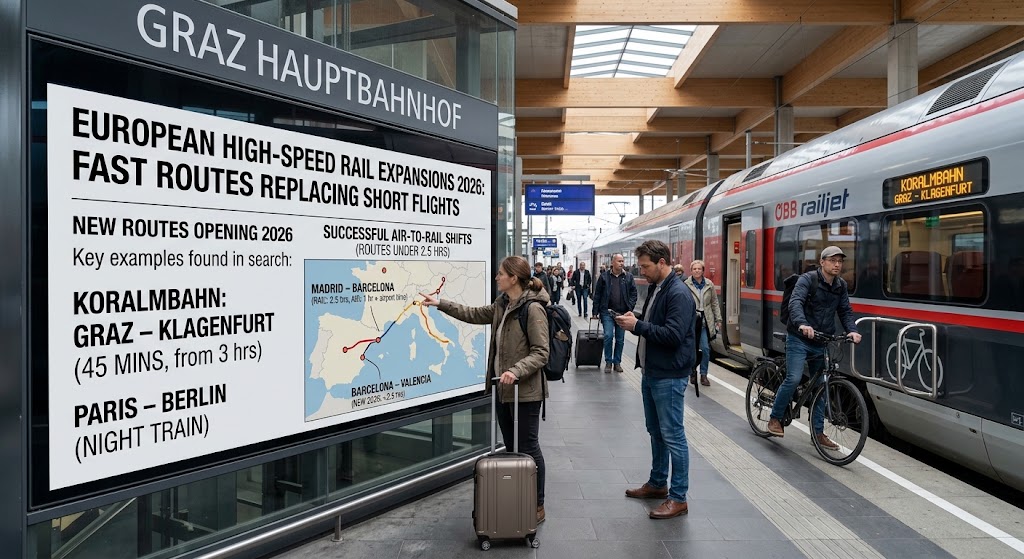
Scenes like this are playing out across the European continent with increasing frequency. After decades in which low-cost aviation dominated cross-border travel, Europe is undergoing a massive, multi-billion-euro railway renaissance. Fueled by aggressive climate mandates, government flight restrictions, and unprecedented infrastructure investments, high-speed rail is mounting a direct challenge to regional airlines.
What began as a localized effort to connect national capitals has evolved into an interconnected, pan-European network. Across major transit corridors, the flight is no longer the default choice for middle-distance travel—it is rapidly becoming an outdated one.
The Great Modal Shift on Continental Corridors
The economic logic governing European travel is undergoing a fundamental realignment. Historically, low-cost carriers dominated short-haul travel by offering headline fares that rail operators struggled to match on cross-border routes. However, as total travel time, urban convenience, and environmental costs are factored into the equation, high-speed rail is capturing dominant market shares wherever reliable, fast infrastructure exists.
Transportation economists track a clear phenomenon known as the “four-hour rule.” When a high-speed rail link reduces total downtown-to-downtown travel time between two major cities to under four hours, rail routinely captures more than 60 percent of the combined air-rail passenger market. When travel time drops below three hours, aviation market share on that specific corridor frequently collapses entirely.
The precedent was established on domestic trunks like Paris–Marseille, Madrid–Barcelona, and Rome–Milan, where bullet trains virtually wiped out competing air routes. Now, that same dynamic is expanding across international borders.
Passengers are recognizing that a two-hour flight actually represents a five- or six-hour door-to-door ordeal once airport commutes, security screening, early gate arrivals, and baggage retrieval are calculated. High-speed rail eliminates that administrative friction, converting wasted transit hours into productive, comfortable travel time directly between city centers.
Regulatory Pressure and the End of the Short Flight
The expansion of Europe’s rail network is not merely a response to consumer preference; it is propelled by direct legislative intervention. European policymakers are actively targeting short-haul aviation as part of broader decarbonization mandates, recognizing that short flights generate significantly higher carbon emissions per passenger-kilometer than electric rail travel.
France pioneered this regulatory shift by officially banning domestic commercial flights on routes where a direct train alternative exists with a journey time under two and a half hours. The legislation eliminated air links between Paris-Orly and regional hubs like Nantes, Bordeaux, and Lyon, redirecting thousands of daily travelers onto France’s TGV network.
Similar policy frameworks are taking shape across the continent:
- Spain: National climate strategies include provisions to phase out domestic flights where rail travel time sits under two and a half hours, targeting busy corridors like Madrid to Valencia or Seville.
- Austria: Tax structures and state-backed airline bailouts have been tied directly to environmental conditions, forcing the cancellation of short regional flight legs—such as Vienna to Salzburg—in favor of ÖBB’s high-speed Railjet services.
- EU-Wide Initiatives:The European Commission’s updated High-Speed Rail Action Plan seeks to double high-speed rail traffic by 2030 and triple it by 2040, using regulatory pressure and transport funding to prioritize rail over short-haul aviation across the 27-member bloc.
As carbon taxes on aviation fuels increase and regional airports face tightening environmental constraints, the economic incentives favor train operators capable of moving thousands of passengers cleanly across national boundaries.
The Engineering Marvels Shrinking Continental Distances
Connecting Europe’s historically fragmented national rail lines requires overcoming formidable geographic and structural barriers. A wave of monumental megaprojects—underway or reaching completion across the Trans-European Transport Network (TEN-T)—is engineering away physical bottlenecks that previously forced passengers into the air.
The Fehmarnbelt Fixed Link
Stretching beneath the Baltic Sea between Denmark and Germany, the Fehmarnbelt Fixed Link is the world’s longest immersed tunnel. Once operational, it will bypass lengthy detour routes and ferry crossings, cutting rail travel times between Hamburg and Copenhagen from over five hours to roughly two and a half hours. This connection will integrate Scandinavia directly into the high-speed rail corridors of Central Europe.
The Lyon–Turin Base Tunnel
Cutting deep beneath the Alps, the 57-kilometer Lyon–Turin base tunnel will establish a direct, high-speed rail line between eastern France and northern Italy. By replacing steep, winding mountain passes with a flat, high-speed route, passenger travel times between Paris and Milan will drop from nearly seven hours to under four, positioning rail as the uncontested leader on one of Southern Europe’s busiest business corridors.
Rail Baltica
For decades, the Baltic states—Estonia, Latvia, and Lithuania—operated on a legacy broad-gauge rail footprint inherited from the Soviet era, physically separating them from Central Europe’s standard-gauge network. Rail Baltica is a greenfield mega-infrastructure project constructing a 870-kilometer standard-gauge high-speed line from Tallinn through Riga and Vilnius down to Warsaw. The line will bring high-speed rail travel to Northeastern Europe for the first time, replacing regional flights with seamless land connections.
The Brenner Base Tunnel
Connecting Innsbruck in Austria to Franzensfeste in Italy, the 55-kilometer Brenner Base Tunnel will eliminate one of Central Europe’s most congested freight and passenger chokepoints. By providing a flat route through the Alps, the tunnel will significantly accelerate passenger travel along the high-capacity Munich–Verona corridor.
Open-Access Competition: The Price War on the Rails
Historically, national railway companies operated as state-backed monopolies, resulting in high ticket prices, limited service innovation, and protective cross-border arrangements. The European Union’s market liberalization directives have dismantled those monopolies, ushering in an era of “open-access” competition that is driving down fares and boosting passenger capacity.
When independent operators are permitted to run trains along the same tracks as legacy state carriers, passenger volumes surge and ticket prices fall.
THE OPEN-ACCESS COMPETITION EFFECT

SINGLE STATE MONOPOLY (Legacy Era)
High ticket prices + Fixed daily departures + Limited service innovation

MULTI-OPERATOR COMPETITION (Modern Liberalized Era)
30%–50% price reductions + High-frequency scheduling + Rapid fleet upgrades
The impact of open access is demonstrated most clearly across three key markets:
- Spain: The arrival of low-cost operator Ouigo (a subsidiary of France’s SNCF) and private operator Iryo alongside Spain’s state-owned Renfe transformed the high-speed network. Fares on the flagship Madrid–Barcelona route dropped by more than 40 percent, leading to record-breaking passenger numbers and drawing thousands of commuters off domestic flights.
- Italy: Competition between state operator Trenitalia and private high-speed operator Italo turned the Milan–Rome corridor into a case study in rail dominance. High-frequency service and competitive pricing forced national airline Alitalia to bankruptcy and led to the complete cancellation of dedicated domestic air routes along that line.
- Cross-Border Routes: Private operators like FlixTrain and new open-access startups are expanding across Germany, France, and the Low Countries, offering low-cost passenger rail that directly targets the price-sensitive demographic previously monopolized by budget airlines.
By forcing operators to compete on price, onboard amenities, and booking flexibility, open-access competition is making high-speed rail financially accessible to everyday travelers rather than reserving it for corporate expense accounts.
Technical and Ticketing Friction: The Obstacles Ahead
Despite massive infrastructure progress, building a unified European high-speed network faces significant technical and administrative hurdles. Unlike national airspace, which operates under standardized international protocols, Europe’s rail systems carry a legacy of fragmented engineering standards.
System Interoperability
Cross-border trains must navigate a complex mosaic of national technical specifications. A locomotive traveling from Germany into France or Italy must be equipped to handle different electrical track voltages, distinct overhead catenary heights, and multiple legacy signaling systems.
The European Railway Traffic Management System (ERTMS) is designed to replace these mismatched national controls with a single, digital signaling standard. However, retrofitting existing locomotive fleets and trackside infrastructure remains a costly, slow-moving process that continues to delay cross-border service rollouts.
The Ticketing Nightmare
While passengers can easily book a multi-leg flight itinerary across four different airlines through a single search portal, booking a multi-country train journey across Europe remains frustratingly disjointed. National rail operators frequently refuse to share real-time ticketing data or allow third-party platforms to sell integrated tickets.
As a result, a passenger traveling from Amsterdam to Marseille via Brussels may need to purchase separate tickets from different operator websites. If a delay on the first leg causes the passenger to miss a connection, they often lack legal protection or guaranteed rebooking on the next train—a stark contrast to established aviation passenger rights.
European consumer advocacy groups and passenger federations are pushing the European Union to enforce mandatory open-ticketing frameworks and unified passenger rights across all international rail operators.
The Economic and Climate Calculus
The transition from aviation to high-speed rail carries massive macroeconomic and environmental implications.
From an environmental standpoint, electric high-speed rail is vastly superior to aviation. A high-speed train powered by a renewable energy grid emits up to 90 percent less carbon dioxide per passenger than an equivalent regional flight. In an era where corporate ESG metrics and individual environmental awareness dictate travel decisions, high-speed rail provides the only scalable way to maintain high mobility while meeting stringent emissions targets.
However, the capital required to build high-speed rail infrastructure is astronomical.Completing the core European TEN-T high-speed network by 2040 is estimated to cost at least €345 billion, with expanded high-speed scenarios reaching up to €546 billion.
Unlike commercial aviation, where airlines purchase aircraft and pay landing fees to existing airport terminals, high-speed rail requires extensive civil engineering: tunneling through mountain ranges, constructing long viaducts, laying specialized track ballast, and acquiring land rights through densely populated corridors.
THE REALITY OF THE MODAL SHIFT

FINANCIAL INVESTMENT
* TEN-T Core Completion Cost: €345 Billion – €546 Billion
* Projected Societal Net Benefit: ~€750 Billion

ENVIRONMENTAL IMPACT
* Direct carbon reduction: Up to 90% per passenger-kilometer vs. short-haul flights
* Unlocks regional economic development along secondary corridor stops
Proponents argue that these capital expenditures yield generational returns. Unlike aviation investments, which primarily benefit airline operators and airport authorities, high-speed rail infrastructure delivers long-term public dividends: relieving highway congestion, spurring economic development in secondary regional cities along transit corridors, and providing energy-independent transport for centuries.
The Map of Tomorrow
The transformation of European transit is fundamentally altering how people perceive time and distance across the continent.
By the mid-2030s, major structural projects will merge previously isolated national corridors into a unified continental grid:
- Berlin to Copenhagenin under four hours.
- Paris to Rome in under nine hours via high-speed day and night services.
- Sofia to Athensin six hours, cutting current travel times in half.
- Paris to Lisbon via Madrid connected entirely by high-speed rail corridors.
The short-haul flight is losing its cultural and commercial dominance across Europe. As steel tracks replace air corridors, the continent is returning to a transit model built on land, community integration, and environmental responsibility.
For the modern traveler, the future of European travel is not found at 30,000 feet in an airport holding pattern. It is found on the platform, watching the signal turn green as a high-speed train quietly pulls out of the station and accelerates into the landscape.