
At airport departure gates from London to Chicago, a daily scene of tension plays out with predictable regularity. Passengers shuffle toward the boarding desk, nervously sizing up their roller bags against rigid metal frames while airline agents eye overhead luggage with mathematical scrutiny. For more than fifteen years, the soft-sided carry-on suitcase has served as the primary battleground in the war over airfare transparency.
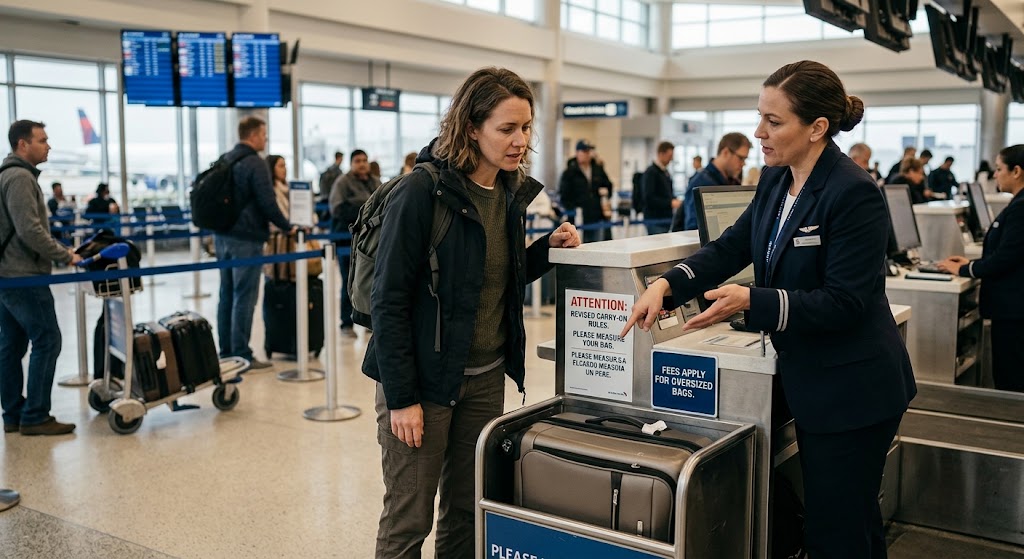
Now, that battleground is undergoing a fundamental regulatory and operational shift.
Sweeping passenger rights revisions in the European Union, alongside heightened regulatory scrutiny from transport authorities in North America and Asia, are forcing airlines to overhaul how hand luggage is measured, advertised, and priced. After years of aggressive “unbundling”—a business model that stripped ticket prices down to the bare metal while charging extra for everything from overhead bin space to printed boarding passes—regulators are pushing back.
New standards aim to enforce price transparency by requiring carriers to include standard cabin baggage allowances in their default advertised fares and standardize baggage dimensions across operating fleets.
While consumer advocates celebrate these changes as a long-overdue victory against deceptive “junk fees,” the economic reality for travelers is far more complex. Airlines are not expected to simply absorb lost baggage revenue. Instead, the overhaul of hand-luggage rules is triggering a profound recalibration of airfare economics, altering baseline ticket prices, shifting operational bottlenecks to the boarding gate, and forcing carriers to find new ways to protect their profit margins.
The Ancillary Revenue Empire: How Unbundling Built the Modern Budget Airline
To understand why hand-luggage regulations matter so deeply to airfares, one must first examine the financial machinery of modern commercial aviation.
Twenty years ago, purchasing an airline ticket was an all-inclusive transaction. A standard economy fare covered the seat, a checked suitcase, a carry-on roller bag, a personal item, and a modest inflight meal.
The rise of the ultra-low-cost carrier (ULCC) model, pioneered by European giants like Ryanair and EasyJet and later adopted by American carriers such as Spirit and Frontier, completely dismantled that structure. Airlines realized that by unbundling services, they could advertise extraordinarily low baseline fares—often $15 or €19—to dominate internet search engine rankings.
THE ANCILLARY REVENUE EVOLUTION

TRADITIONAL BUNDLED FARE
Single ticket price includes: Seat assignment + Overhead cabin bag + Under-seat personal item + Checked bag

UNBUNDLED ULTRA-LOW-COST FARE
Base fare includes: Seat + Under-seat personal item only
Optional Add-ons: Overhead cabin bag ($30-$60) + Seat selection ($15-$40) + Priority boarding ($20-$35)
Unbundling transformed hand luggage from a basic customer utility into a primary profit engine. By shrinking the free “personal item” allowance to the dimensions of a small school backpack, airlines created artificial scarcity in the cabin. If a passenger wanted to bring a standard five-day wardrobe in a rolling suitcase, they were forced to purchase a “Regular” fare tier, buy a “Priority Boarding” pass, or pay an à la carte cabin-bag fee at checkout.
This strategy generated billions. Industry-wide, ancillary revenues—income derived from non-ticket fees—expanded from less than $15 billion globally in the mid-2000s to well over $100 billion annually. For many low-cost airlines, ancillary fees came to represent 30% to 50% of total company revenue. In financial terms, these carriers became marketing and logistics companies that happened to fly aircraft, earning higher profit margins on overhead bin space than on the physical transport of the passenger.
The Regulatory Crackdown: Standardization and Upfront Transparency
The unbundled model created extraordinary commercial success for airlines, but it generated equal amounts of consumer frustration. Search engines routinely displayed ultra-cheap flights that quadrupled in price by the final payment screen once standard hand luggage was added.
Regulators have stepped in to curb these practices.
The European Union has led the global push, passing updated passenger rights frameworks designed to eliminate hidden fees and standardize cabin conditions across all airlines operating within the bloc.
The regulatory mandates focus on three core pillars:
- Mandatory Default Fare Displays: Airlines operating within EU jurisdiction are required to display default ticket prices that clearly include a standard carry-on allowance—encompassing both a small under-seat personal item and a larger overhead cabin bag (typically up to 7 kilograms)—before the customer begins the booking process.
- Dimension Standardization: Regulatory bodies are moving to establish uniform maximum dimensions for cabin luggage across all carriers, targeting standard limits of 55 x 40 x 20 centimeters for overhead bags and 40 x 30 x 15 centimeters for under-seat items. This eliminates the confusing maze of varying millimeter limits that previously resulted in unexpected gate penalties when passengers transferred between different airlines.
- Fee Transparency Bans: Regulators are cracking down on dynamic, hidden baggage pricing, requiring airlines to publish fixed, clear baggage fee schedules rather than adjusting cabin-bag prices algorithmically during checkout based on flight demand.
Similar regulatory movements are gaining traction elsewhere. In the United States, the Department of Transportation (DOT) has enacted stricter transparency rules requiring airlines to disclose all ancillary fees—including carry-on charges, seat selection costs, and change penalties—upfront the moment a fare is first displayed to a consumer.
Consumer advocates argue that these measures restore basic market fairness. When baggage costs are built into advertised baseline prices, travelers can make genuine, head-to-head price comparisons between competing airlines without navigating deliberate digital traps designed to inflate the final bill.
The Airfare Equation: Why “Free” Carry-Ons Will Raise Baseline Ticket Prices
While standardized rules and inclusive default fares sound like an unqualified win for consumers, they introduce an immediate economic paradox: making hand luggage an included right will inevitably increase headline airfares.
Airline pricing is governed by sophisticated yield management algorithms designed to extract maximum revenue from every flight. When a regulatory mandate restricts an airline’s ability to charge for a high-margin product—such as overhead bin space—the airline does not simply forfeit that income. Instead, it re-engineers its base pricing structure to recover the shortfall.
AIRFARE RESTRUCTURE DYNAMICS

PRE-REGULATION (UNBUNDLED MODEL)
* Advertised Base Fare: $25
* Mandatory Carry-On Fee: $35
* Total Out-of-Pocket Cost: $60
* (Ultra-light travelers pay only $25)

POST-REGULATION (BUNDLED TRANSPARENCY MODEL)
* Default Advertised Fare: $55 - $60 (Includes carry-on by default)
* Optional "No-Bag" Discount Tier: $45
* (Ultra-light travelers face higher baseline costs; headline prices rise)
The End of the Lead-In Fare
The most immediate consequence of cabin-bag inclusion is the extinction of the headline $15 or €19 airfare. Because airlines must advertise default prices that account for hand luggage, search engine display prices will rise across the board. The starting price for a short-haul flight will shift upward to reflect the bundled cost of the seat and the bag.
The Cross-Subsidization Shift
Under the fully unbundled model, passengers who traveled with only a small backpack subsidize the overall flight operation while paying a minimal fare, leaving travelers with larger suitcases to bear a higher share of the revenue load.
When carry-on luggage is built into default fares, this dynamic flips. Ultra-light travelers end up paying a higher base price that accounts for overhead bin space they may not even use, effectively cross-subsidizing passengers who pack heavy rolling cases—unless airlines maintain complex, discounted “no-bag” opt-out tiers.
Fare Class Fragmentation
Rather than offering a single unified fare, airlines are responding to regulations by creating hyper-fragmented ticket buckets. A carrier might display a compliant, higher-priced “Default Standard” fare that includes a 7kg cabin bag to satisfy legal requirements, while simultaneously offering a buried, deeply discounted “Basic Saver” tier for travelers willing to waive their carry-on rights.
While this technically complies with transparency mandates, it preserves the airline’s ability to segment price-sensitive tourists from business travelers.
The Physical Bottleneck: Aircraft Capacity and Gate Enforcement
Beyond pure economics, revising hand-luggage rules exposes a hard physical constraint that no legal regulation or corporate pricing model can alter: the internal dimensions of a commercial jet cabin.
The physics of modern narrow-body passenger aircraft—such as the Boeing 737-800 or the Airbus A320, which form the backbone of global short-haul fleets—were designed long before airlines began charging for checked hold luggage.
NARROW-BODY AIRCRAFT CAPACITY MISMATCH

Passenger Capacity: 180 to 230 passengers
Overhead Bin Physical Limit: 90 to 110 standard roller bags
Available Overhead Capacity: ~50% of total passenger load
A fully loaded Airbus A320 carries between 180 and 195 passengers. However, even with modern, enlarged overhead “pivot bins,” the cabin can physically accommodate only 100 to 115 standard rolling suitcases.
Under the unbundled fee model, charging $30 to $50 for a cabin bag served as an artificial demand-suppression tool. High fees discouraged a large percentage of passengers from bringing large bags aboard, keeping overhead demand roughly aligned with available physical space.
If regulatory reforms make carry-on bags “free” or bundle them into standard baseline fares for every passenger, demand for overhead bin space will immediately exceed capacity on almost every full flight.
This capacity gap shifts operational friction directly to the boarding gate:
- Involuntary Gate-Checking: Gate agents will be forced to intercept dozens of compliant carry-on bags at the jetway and send them down into the cargo hold once overhead bins reach capacity. This creates confrontation with passengers who specifically chose carry-on travel to avoid waiting at baggage claim carousels.
- Threats to Turnaround Times: Budget airline profitability relies on extreme fleet utilization—landing an aircraft, unloading passengers, boarding the next flight, and taking off again within 25 to 30 minutes. Searching for empty bin space, re-stowing oversized bags, and processing last-minute gate-checked luggage causes boarding delays that ripple across an airline’s daily flight schedule.
- The Rise of “Weight Policing”: To manage cabin volume without violating dimension rules, airlines are pivoting from measuring bag sizes to strictly enforcing weight limits. Carriers are deploying digital scales at boarding gates to enforce rigid 7-kilogram (15.4 lb) maximum limits. A rolling bag that easily meets size requirements can be rejected and assessed a heavy gate-check penalty if it weighs 8.5 kilograms, allowing the airline to manage cabin weight and generate penalty revenue simultaneously.
The Waterbed Effect: Where Airlines Will Shift Their Fees
In airline economics, revenue management follows what industry analysts call the “Waterbed Effect”: press down on revenue in one area, and it inevitably pops up in another. If regulations restrict an airline’s ability to profit from basic hand luggage, carriers will re-engineer their ancillary fee structures elsewhere to protect their overall yields.
Travelers should expect airlines to aggressively monetize alternative aspects of the travel experience:
1. Unbundling “Guaranteed” Overhead Space
Airlines are beginning to separate the legal right to bring a carry-on bag from the physical guarantee that the bag will travel in the cabin with you. Carriers will offer basic fares that permit a cabin bag subject to available space, while selling premium “Guaranteed Overhead Space” passes that reserve specific bin slots above your seat row.
2. Premium Seat Monetization
As baggage fees face regulatory caps, airlines are increasing charges for advance seat selection. Standard window and aisle seats, front-of-cabin access, and extra-legroom rows are seeing higher, dynamically priced fees. Families wishing to sit together without being split up by automated seat-assignment algorithms represent a reliable revenue source that airlines will continue to monetize.
3. Inflating Checked Hold Baggage Rates
To deter passengers from shifting heavy packing habits to the cargo hold, airlines are raising prices on checked suitcases. By widening the price gap between cabin bags and hold bags, airlines encourage passengers to pack lighter, reducing total aircraft fuel burn while maximizing hold space for commercial cargo freight.
Navigating the New Landscape: A Playbook for Travelers
As airlines revise their hand-luggage rules and airfares adjust to new regulatory standards, travelers must adapt their strategies to avoid paying inflated overall travel costs.
Look at Total Ticket Value, Not Headline Display Fares
With airlines restructuring fare displays to comply with transparency laws, the lowest displayed price on a booking engine may no longer represent an automatic bargain. Travelers should calculate the total end-to-end journey cost—including seat assignments, transit to central airports, and baggage allowances—across both low-cost carriers and full-service legacy airlines. In many cases, traditional full-service airlines that include generous hand-luggage allowances and seat selection by default are becoming cost-competitive with budget rivals once total pricing is calculated.
Transition from Hard-Shell Rollers to Soft-Sided Backpacks
The traditional hard-shell rolling suitcase, with its rigid frame and exterior wheels, is increasingly poorly suited for modern airline carry-on rules. Exterior wheels consume precious inches of allowable dimensions, and rigid shells cannot squeeze into packed overhead bins or under seats.
Savvy travelers are shifting toward specialized soft-sided travel backpacks designed precisely to maximum allowed dimensions. Soft bags offer higher internal volume per cubic centimeter, weigh significantly less (helping passengers stay under strict 7kg caps), and can compress to fit into airport sizing boxes or crowded overhead spaces.
Invest in a Portable Luggage Scale
As airlines shift their gate enforcement from bag dimensions to strict weight compliance, carrying an inexpensive digital luggage scale has become essential. Weighing a carry-on bag at home or in a hotel room before departing for the airport prevents catastrophic gate-check penalties that can easily reach $60 to $100 if a bag exceeds the 7kg limit by even a fraction of a kilogram.
A Structural Realignment for Global Aviation
The regulatory overhaul of airline hand-luggage rules marks the end of an era in commercial aviation. The wild-west period of ultra-unbundled pricing—where airlines could advertise a $15 flight and quietly charge three times that amount at checkout for a basic suitcase—is closing down under regulatory pressure and consumer demand for transparency.
However, regulatory mandates cannot change the fundamental economics of flying. Planes require fuel, flight crews require compensation, aircraft demand maintenance, and overhead storage space remains physically limited. When regulators eliminate hidden carry-on fees, airlines will re-adjust their pricing models to ensure their overall profitability remains intact.
For travelers, the coming landscape will bring greater upfront pricing clarity and standardized cabin rules, but it will also bring higher baseline ticket prices and stricter enforcement at the boarding gate. Understanding this economic reality allows passengers to look past marketing claims, pack with precision, and navigate the changing skies without facing expensive surprises at checkout.