
Stepping through security into an international departure lounge, travelers encounter a carefully engineered sensory gauntlet. Rows of brightly lit glass cases display crystal decanters of aged Scotch, towering pyramids of oversized chocolate bars, and glowing counters stacked with designer fragrances. The air smells of rival perfumes, and bold promotional signs proclaim tax-free savings to a captive audience of waiting passengers.
For nearly eight decades, airport duty-free shopping has been sold as one of the few legal loopholes of international travel—a tax-sheltered playground where vacationers could pick up luxury goods, fine spirits, and cosmetics at a fraction of high-street prices. Born in 1947 at Shannon Airport on the windswept west coast of Ireland, the concept was simple: goods sold to passengers leaving national territory should not be subject to local value-added tax (VAT) or customs duties.
Today, however, the financial reality of the departure lounge looks vastly different. The rise of e-commerce algorithms, dynamic pricing models, skyrocketing airport operating costs, and shifting consumer expectations have quietly eroded the duty-free value proposition.
While the global travel retail industry continues to expand toward an estimated $80 billion market, savvy holidaymakers are discovering that “duty-free” no longer automatically translates to “discount”. Navigating the modern terminal requires looking past the shiny promotional displays to understand where genuine savings remain—and where travelers are simply paying a premium for transit convenience.
The Hidden Economics of the Terminal Floor
The fundamental misunderstanding among most travelers lies in the distinction between “duty-free” and “markup-free”.
When a retailer operates in an international departure zone, it is exempt from collecting local sales taxes or import duties on eligible goods. In theory, removing a 20 percent Value-Added Tax (VAT) should lower the sticker price by a corresponding amount. In practice, however, the retailer retains total freedom over its baseline pricing structure.
Airport retail space is among the most expensive commercial real estate in the world. Airport authorities frequently charge duty-free concessionaires—global giants such as Avolta (formerly Dufry), Lagardère, and Dubai Duty Free—astronomical rents alongside concession fees that can swallow 30 to 40 percent of gross sales revenue.
To maintain profitability under these immense operational overheads, duty-free operators inflate their baseline profit margins. As a result, the tax exemption that was meant to benefit the consumer is frequently absorbed entirely by the retailer’s rent obligations. A bottle of perfume or a pair of designer sunglasses may technically be free of local sales tax, but its underlying markup can easily render it more expensive than the exact same item purchased online or from a competitive downtown retailer.
Category Breakdown: Where the Real Deals (and Traps) Live
Not all duty-free categories are created equal. The degree of value depends heavily on the specific product, the tax structure of the origin country, and the regional pricing strategy of the manufacturer.
Spirits and Tobacco: The Strongest Remaining Value
Spirits and tobacco products remain the undisputed kings of airport duty-free savings. This is because these items are subject to heavy domestic “sin taxes,” excise duties, and luxury tariffs in most nations.
When buying high-proof spirits or cigarettes at the airport, the tax savings are often substantial enough to overcome high retail markups. For example, travelers departing from countries with high alcohol excise rates—such as Sweden, the United Kingdom, or Australia—can routinely save 20 to 40 percent on premium single malt whiskies, gin, or cognac compared to domestic liquor stores.
However, price variations between airports remain pronounced. European hubs like Stockholm and Warsaw often offer significantly better deals on spirits than hyper-luxury airports like Dubai or London Heathrow, where high concession costs push spirit prices closer to high-street levels.
Fragrances and Cosmetics: The Unpredictable Middle Ground
Cosmetics, skincare, and fragrances occupy a complex middle tier. Standard single items—such as a 50ml bottle of designer cologne or a single tube of luxury lipstick—rarely offer significant savings over competitive online beauty outlets or high-street promotions.
Where cosmetics duty-free shopping delivers genuine value is through Travel Retail Exclusives and bundled sets. Beauty conglomerates specifically manufacture dual-pack creams, 100ml fragrance bottles, and curated palette kits for transit retail. These bundled configurations are structured to provide a 15 to 25 percent price-per-milliliter advantage compared to buying individual units at standard retail stores.
Electronics, Fashion, and Accessories: The Clear Value Traps
Consumer electronics, designer sunglasses, luxury leather goods, and fashion accessories represent the least economical duty-free purchases.
Unlike alcohol, consumer electronics carry minimal import duties in most developed economies, meaning the “tax-free” savings are negligible from the outset. Furthermore, global consumer tech pricing is highly transparent and competitive. An iPad, wireless noise-canceling headphones, or a smartwatch sold at an airport tech kiosk will almost always cost more than what a consumer can find through major online retailers, which frequently run sales, trade-in programs, and seasonal discounts that airport shops cannot match.
Similarly, designer fashion boutiques inside airport terminals cater to high-net-worth travelers operating on impulse. Unless a traveler is taking advantage of a specific tax-refund scheme that offers a cash rebate at the border, buying designer apparel at the airport rarely yields a genuine bargain.
The Digital Transformation: Pre-Order and Omnichannel Travel Retail
To combat declining foot traffic and changing consumer habits, the global travel retail sector is undergoing a massive digital overhaul.
Historically, duty-free relied on captive, bored travelers browsing store aisles during long layovers. Today, international airports—including London Heathrow, Frankfurt, Singapore Changi, and Dubai International—have integrated robust e-commerce “Reserve & Collect” platforms.
This digital shift alters the economics of travel shopping. By allowing passengers to order products via smartphone apps days before their flight, travel retailers reduce the need for massive floor inventory and high sales staff overhead. To incentivize pre-ordering, duty-free operators routinely offer an additional 10 to 15 percent discount on pre-booked items, allowing disciplined travelers to stack savings on top of tax exemptions.
Furthermore, pre-order systems solve one of the most frustrating aspects of duty-free travel: carrying heavy glass bottles or bulky shopping bags through security connections and crowded boarding gates. Integrated fulfillment models now allow passengers to pick up their purchases upon landing back at their home airport, or have items delivered directly to their aircraft seat.
Currency Tricks and Payment Traps at the Register
Even when a traveler locates a genuinely discounted item in duty-free, poor payment practices at the cash register can silently wipe out the savings.
Airport retail terminals are prime environments for Dynamic Currency Conversion (DCC). When presenting a payment card at an international duty-free counter, the payment terminal will frequently display the total cost in the traveler’s home currency (e.g., USD or GBP) rather than the local currency of the airport terminal.
Selecting your home currency at an airport register allows the merchant processor to apply an inflated foreign exchange rate with built-in markups ranging from 5 to 10 percent.
To protect your savings:
- Always instruct the cashier to charge your card in the local currency of the airport you are physically standing in.
- Use a primary credit card or multi-currency travel card that charges zero foreign transaction fees.
The Pivot to Experiential Luxury and “Exclusives”
Recognizing that basic price discounting is no longer enough to attract modern travelers who can price-check items on their smartphones in seconds, duty-free operators are pivoting away from purely transactional selling. The future of airport retail lies in experiential luxury and absolute product exclusivity.
Major spirits conglomerates now reserve their rarest allocations, single-cask bottlings, and unique wood-finished whiskies exclusively for travel retail distribution. These products cannot be purchased at domestic liquor stores or online retail platforms at any price. For collectors and connoisseurs, buying at the airport is no longer about saving $10 on a standard bottle; it is about securing access to limited-edition releases.
Similarly, global luxury brands are redesigning airport terminals to feature immersive brand sanctuaries—including high-end cocktail lounges, personalized fragrance customization bars, and private VIP shopping suites. By converting transit waiting time into an entertaining, premium lifestyle experience, travel retailers are successfully capturing higher-margin spending from affluent international travelers.
The Modern Duty-Free Playbook: How to Shop Smart
Duty-free shopping is far from dead, but the days of blindly trusting airport price tags are over. To extract real value from travel retail, holidaymakers should adopt a systematic playbook:
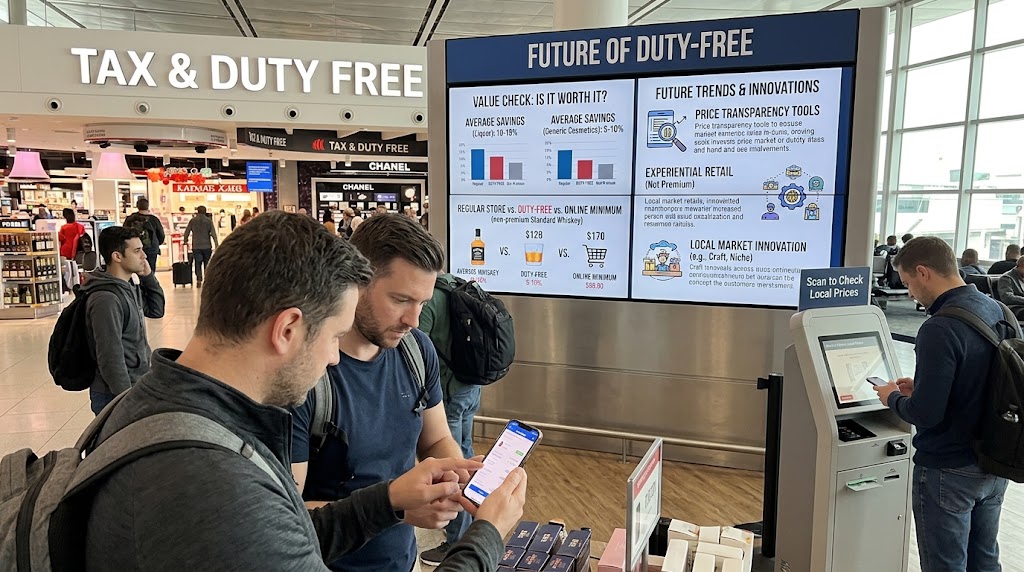
- Perform the 30-Second Smartphone Audit: Before approaching the register, search for the exact product on a mobile browser. Compare the airport price against major online retailers in your home country, taking local sales tax into account. If the airport price isn’t at least 15 percent cheaper, skip the purchase.
- Focus Strictly on High-Tax Categories:Target items that suffer from heavy domestic excise duties at home—specifically high-proof spirits, cigars, and specialized tobacco products.
- Target Travel Exclusives and Value Bundles: Look for category-specific travel sets, multi-item beauty packs, and non-distributive spirit releases that offer structural volume discounts.
- Bypass Consumer Electronics and Fashion: Avoid purchasing headphones, tablets, designer sunglasses, or apparel at the airport unless you are filling an urgent travel need or making use of an official, government-backed tax-refund processing counter.
- Utilize Reserve-and-Collect Apps: Use official airport shopping portals to pre-order items 48 hours prior to departure, unlocking digital discounts and avoiding long queue delays.
- Know Your Customs Allowances:Always verify the duty-free import limits enforced by your destination country (e.g., 1 liter of spirits and 200 cigarettes for entry into the U.S. or UK). Exceeding statutory personal allowances triggers heavy customs fines and retroactive import taxes upon arrival, instantly destroying any price savings achieved at departure.
Airport duty-free shopping has evolved from an automatic discount bazaar into a specialized, highly curated retail market. By stripping away the psychological illusion of “tax-free” magic and treating airport terminals with the same price skepticism as any high-street store, travelers can avoid expensive transit traps and secure genuine bargains on the road.